

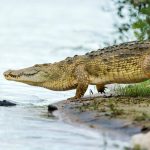
Incredible facts about crocodiles reveal why these ancient reptiles remain among the most successful predators on Earth. Having survived for over 200 million years, crocodiles are perfectly adapted to both aquatic and terrestrial environments. Their biology, behavior, and evolutionary history demonstrate extraordinary resilience, precision, and intelligence. Below are some of the most fascinating facts that highlight why crocodiles continue to dominate wetlands and rivers across Africa and beyond.
Their Name Has Origins in Ancient Greek.
One of the lesser-known interesting facts about crocodiles lies in the origin of their name. The word crocodile comes from the Ancient Greek term “krokodilos” (κροκόδιλος), derived from krokē meaning “pebble” and drilos meaning “worm.” Together, the phrase loosely translates to “pebble worm,” likely inspired by the reptile’s rugged, stone-like skin and elongated body.
Originally, krokodilos referred to small lizards, but as Greek explorers encountered the massive Nile crocodiles, the name was adopted for these larger reptiles. Their armored, bumpy scales and serpentine form closely match this ancient description, making the name remarkably accurate even today.
Temperature Determines Their Gender.
Among the most fascinating facts about crocodiles is their reliance on temperature-dependent sex determination (TSD). Unlike mammals and many other animals, where genetics determines sex, crocodile hatchlings develop as male or female based entirely on incubation temperature.
After mating, female crocodiles carefully select nesting sites—either shallow pits or vegetation mounds—where they may lay up to 90 eggs. During the roughly three-month incubation period, temperature plays a critical role:
- Males typically hatch at temperatures between 32°C and 34°C (89°F–93°F)
- Females are more likely at temperatures below 31°C (88°F) or above 34°C (93°F)
This delicate balance is essential for maintaining stable crocodile populations in the wild.
Crocodiles Are Engineered for Stealth and Strength.
Interesting facts about crocodiles often surprise people who underestimate their speed. Despite their heavy, armored appearance, crocodiles are exceptionally fast swimmers, reaching speeds of 15–18 mph (24–29 km/h) in short bursts. This makes them highly effective ambush predators.
On land, they can sprint up to 11 mph (17 km/h) over short distances. Their most astonishing feature, however, is their bite force—measuring up to 5,000 pounds per square inch, one of the strongest in the animal kingdom. With 60–110 razor-sharp teeth, crocodiles can crush bones and turtle shells with ease. Video of Crocodile Hunts.
Their Signature Hunting Technique Is the Death Roll.
Another iconic entry among interesting facts about crocodiles is the death roll. Once a crocodile clamps onto its prey, it rapidly spins its entire body using powerful tail muscles. This violent rotation disorients the prey, tears flesh or limbs, and makes large animals easier to subdue and consume.
The death roll is especially effective when tackling large or resistant prey, demonstrating the crocodile’s unmatched efficiency and raw power in aquatic combat.
Crocodiles Must Sunbathe to Survive.
Crocodiles regularly bask in the sun, a behavior essential to their survival. As ectothermic (cold-blooded) animals, they rely on external heat sources to regulate body temperature.
Basking helps crocodiles:
- Maintain optimal body function
- Boost digestion after large meals
- Conserve energy during cooler periods
In colder conditions, basking becomes more frequent, while in warmer climates, less sun exposure is needed.
They Can Survive Without Food for Months.
One of the most interesting facts about crocodiles is their ability to endure extended periods of fasting. Crocodiles dramatically slow their metabolism when food is scarce, conserving energy by lowering their heart rate and bodily activity. Fat reserves stored in their tails sustain them during long periods without meals.
Large crocodiles can survive 6 to 12 months—and sometimes over a year—without feeding.
In the Mara and Grumeti Rivers of Kenya and Tanzania, crocodiles take full advantage of the Great Migration, preying on wildebeest and zebra during river crossings. Outside this seasonal abundance, they rely on their remarkable endurance to survive until the next opportunity arises.





















![How Did Mount Kilimanjaro Get Its Name? The Fascinating Meaning & History Explained [Expert Guide]](https://www.mateyswildtours.com/wp-content/uploads/2025/06/How-Did-Mount-Kilimanjaro-Get-Its-Name-Meaning-History-Explained-2025-Guide-150x150.jpeg)